viernes, 10 de julio de 2009

I love Chile...do you?

If there is one familiy that loves Chile the most, it is my family. We are not the ones that feel chileans and only dances cueca in September. We feel chilean and we love our country and culture all year long. That is why my mother belongs to a Chilean Folk Ballet, where she, and the rest of the group, go around Chile and South America to show different dances that we should feel proud of.

However, having been to a Peña Folclorica last month and seen few teenagers participating in it, it made me think of how much we love our country; how much we feel identifyed with its culture, what it has been done inside the schools with chilean culture or, going further, how our identity as chileans is changing.

Since I am going to be a teacher of English, this topic of identity is very important to me, because we are going to be teaching a language with a set of characteristic, that “automatically” are inserted in the language. For example, ways of thinking, ways of speaking, ways of treating people; in short, with another different identity. According to the Cambridge dictionary, the meaning of the word “identity” is “who a person is, or the qualities of a person or group which make them different from others”.

Marcia Prieto, author of the book “Mejorando la Calidad de la Educación” states that “la escuela como ninguna otra agencia educativa tiene todas las posibilidades de lograr en las personas efectos verdaderamente transformadores si logra recordar que está al servicio del desarrollo de la vida de ellas”. In other words, the school- referring to the school not as the solid entity, but as the people that work there- has all the posibilities to make very noticeable changes. Therefore, it is clearly stated that changes begin from school. I have experienced at school that the majority of the books that English teacher work with show only, for example, short stories from England, pictures from USA, songs from Canada and so on and so forth. What’s with ours? Are our stories meaningless?

Is our culture involved in this topic? Yes. There are several concepts related to this issue. For instance, we have the word acculturation, which according to the Encarta Enciclopedia has two meanings:

1) Cultural change: a change in the cultural behaviour and thinking of a person or group of people through contact with another culture. (Encarta, par 1)

2) Absortion of culture: The process by with somebody absorbs the culture of a society from bith onward. (Encarta, par 2)

If we connect this with the reality in the schools, students, and perhaps English teachers too, are suffering from a change in their “cultural behaviour”, because they have to be all the time in contact with a foreign culture and its features.

Now, very related to acculturation, we have another concept, which is called transculturation. Ramiro Podetti, from Universidad de Motevideo quotes Bronislaw Malinowski, a famous anthropologist. He states that transculturation


“es un proceso en el cual emerge una nueva realidad, compuesta y compleja; una realidad que no es una aglomeración mecánica de caracteres, ni siquiera un mosaico, sino un fenómeno nuevo, original e independiente. Para describir tal proceso, el vocablo de raíces latinas transculturación proporciona un término que no contiene la implicación de una cierta cultura hacia la cual tiene que tender la otra, sino una transición entre dos culturas, ambas activas, ambas contribuyentes con sendos aportes, y ambas cooperantes al advenimiento de una nueva realidad de civilización”


In other words, what we are suffering is the process of transculturation. That is to say, we are building a “potpurri” of our own personality. Now, are we, future teachers, taking into account our own features of our identity when teaching? How are we going to deal with that?

In Chile, we have several aspects of our identity that can be meaningful to our students, depending in the place where they live. For instance, we can teach Chilean myths in the South of Chile, or we can teach them about some important characters related to our history in the rest of our country. That is, what it is called Content Based Instruction. Basically “Content based instruction (CBI) is a teaching method that emphasizes learning about something rather than learning about language.(...)This interest has now spread to EFL classrooms around the world where teachers are discovering that their students like CBI and are excited to learn English this way” (Davis, Stephen, par 1). In short, what this technique suggests is that we shouldn’t care about the language, but the thing we are teaching. For example, there are very good translations of Pablo Neruda’s poems that we can find on the internet. However, we shouldn’t care about grammar (although it is important), but we should be interested in showing who Neruda was, what his contributions are, etc.

To conclude, I think that teaching aspects of our culture can be really fun and meaningful, if we are willing to do so. There are a lot of different strategies that can help you to teach your own country for FL students. It’s not bad to show the students other cultures, because it is necessary for them to know other cultures. But what I’m trying to suggest is that “do not focus your classes on other people’s culture. We, chileans, have a rich country, culturally speaking, that we need to explore.


References

• “Acculturation”. Encarta World English Dictionary 2009, 8 July 2009


• “Content Based Instruction in EFL Contexts”. The Internet TESL journal. 2 February 2003. 8 July 2009

• "Fleeting Consciousness." US News Online 29 June 1998. 25 July 1999 .

• “Identity” Cambridge Advanced Learner's Dictionary, 8 October 2009 http://dictionary.cambridge.org/define_b.asp?key=38918&dict=CALD>


• “Mestizaje y transculturación: la propuesta latinoamericana de globalización”. Eric Courthes’s blog. 21 October 2009. 8 July 2009


• Prieto, M. Mejorando la calidad de la educación. Valparaiso: Ediciones Universitarias de Valparaiso, 2001

• “Transculturation”. Encarta World English Dictionary 2009, 8 October 2009

outline

I.- Introduction:

1) meaning of identity
2) culture, acculturation and transculturation
3) are these topics related?

II.- Body

1) Answer the question (3)
2) How can we teach aspect of our culture in English?
3) ideas for an English class about how to teach identity

III.- Conclusion

martes, 28 de abril de 2009

"What women love most"


What do Nancy Meyers, the director of "What women want" with Mel Gibson and Helen Hunt, Chaucer, writer of "The Wife of Bath´s Tale" and women in general have in common?

That we all ask the same question: What do we really want?

If we realise and compare, the reality from the movie, the song and the book are TOTALLY different. However it seems that the requirements that women have are not being completely fulfiled by men.

Perhaps men will never understand that, for example, we need freedom or we need to be understood. But there's something wise that men always say: "do not try to understand women, just love them"

Nowadays, for men, understanding women has turned into an extremely hard task. If we analize Chaucer's text, the main character, a woman, exposes that women want to be free, to be loved, etc. But, was she really being listened by men? Did men understand her? Are we being listened by today's men?

Now, if we see the film by Mel Gibson, he really tries hard to understand what we want, but in the end, he does not get to any conclusion, because he has difficulties after difficulties when trying to do so.

Having this analized, I didn't get to any conclusion, because there is a vast list of things that we'd want. Even for me it's difficult to say what I really want...

miércoles, 8 de abril de 2009

what's an epic poem, for me?


According to the Cambridge dictionary, epic "describes events that happen over a long period and involve a lot of action and difficulty".

When I read Beowolf, it was really hard to understand it, because of its english. So I looked up on the Internet what is the poem about. Now I can come with a definition.

Taking into account the definition and what I think, an epic poem is a long story told by someone with a hero, structured like a poem, perhaps with rimes, etc.

martes, 31 de marzo de 2009


I couldn’t agree more with the definition in slide nº 7: “no text provides self-contained meaning; literary texts do not exist independently of readers‘ interpretations. A text …is not finished until it is read and interpreted....religious, cultural and social values affect readings” (Kennedy and Gioia, 2005)

I see literature as a recipe in which a chef adds pages full of words, punctuation marks mixed with thoughts and feeling. How will the dinner guests know how that dish tastes if they haven’t even tried it?

It happens the same with literature. How will the readers know what a book is about if they haven’t even read it?

Therefore it is the chef’s job to add the right flavours to the recipe so the guest gives meaning to the dish already prepared.

It is our job, as teachers, to help our students to give meaning to literature. It’s not easy, because we have to bear in mind that all students come with different cultural and social incomes. It’s the same with the recipe. All guest do not have the same taste.

As a conclusion, just like our taste determines the perception of a dish, the ideas that we have in our souls will determine the perception of a masterpiece.

martes, 18 de noviembre de 2008

Modern times?


“Modern times” by Charles Chaplin is one of my favourite films. It shows the biggest economical problem in the US, which, then, affected the whole world. However, you can still laugh of them and ourselves.


“Modern times” makes 1929’s “The great Depression” look amusing, although this period was not. This was also the time when people was really mistreated. Just like “industrial revolution”, the conditions in which the people lived where dreadful, so poor people had to struggle and work really hard day in and day out in order to “survive”.


In “Modern times”, Chaplin plays the role of an enterprise worker. Anyone who sees the film, will notice that he didn’t like his job. I can say, therefore, that this film is the representation of all the people who worked in factories. Also, before this film, I’ve never watched a “black and white” film. I thought that they were antiquated and I didn’t understand them. However, I looked up the word “modern” in the Cambridge dictionary and it is defined as: “designed and made using the most recent ideas and methods”. So, after reading this description, now I understand the reason why Chaplin made these kinds of films.


If we compare that context of Chaplin’s film and this actual context, I think that we are returning to the 1929’s reality. Nowadays banks have broken, prices have highly increased because of Inflation. As people don’t ask for loans in banks (because they are afraid of being unemployed), there’s no “money movement”. As there’s no “money movement”, there are no constructions of new buildings whatsoever, because the people is afraid of investing money in something that, later on, will be “valueless”. Therefore, as there are no constructions, there are more unemployed people.


If we read this, it sounds really sad and discouraging. Are we that bad? Were they, in 1929, that bad as well? There are some investigations that, throughout this era, people killed themselves, because they weren’t brave enough to make every effort to “stay alive”.


To me, the title of the film - “Modern Times”- recalls images of technological devices, which make people’s life and living conditions better. On the contrary, if we take a look at our past, people were underestimated in their jobs and their salary was a clear representation of it.
Although all the sorrow that this time might show, Charles Chaplin’s film gives a splendorous moral out of it: If they didn’t learn from the past, it’s time for us to do so.


To sum up, I will recommend this movie, because it’s a great opportunity to know more about this critical period of all times and also, to make a comparison between their “modern” reality and our “contemporaneous” reality , which is not that different.


lunes, 10 de noviembre de 2008

Critical Thinking, British culture and EFL


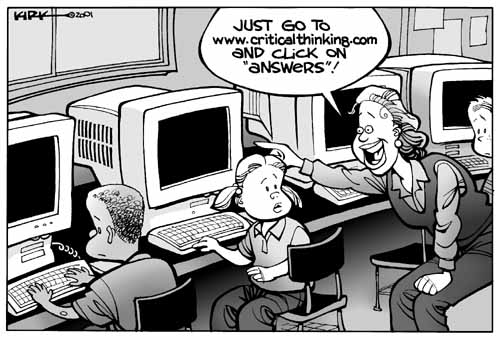
Is it important to teach other cultures, like the British one, to Chilean students? How can we teach it, then? Will it be meaningful for them if they realize that there are other cultures besides theirs? Those are all the questions that come to my mind when thinking in these three issues.


Nowadays, in Chile, students don’t seem to give importance to other cultures. I have experienced that not even our culture is important and I think that this is the Chilean curriculum’s fault. I say this because the curriculum wants the students to learn how to say, for instance, “hello. Where is the bathroom?” and not thinking beyond those superficial topics. In other words, at school they are just worried about teaching grammatical structures. Still, it is not necessary if they are trying to improve Chilean education. The quality of Chilean education is getting worse everyday, because we don’t reflect on certain topics that should be discussed, like cultures. Moreover, children are not able to make their own decisions. Instead, teachers are making the decisions for them, so their metacognitive abilities[1] or strategies are not being worked out well.


Also, Chilean education is getting more and more individualistic, because now everything is focused on results, more than in the process itself, so in the end, the students are not worried whether they learn some subject or not. In its place, they are just focused on their final marks. Also, children are just working on their own result, and the rest is not worth it, unless they help in this final grade. That’s how teacher are creating individualistic students; they don't see what surrounds them. It is true that teachers are asked to grade students, but that should not be their main and only aim.


Would it be better is students were worried about other cultures in order to learn from them? Why don't teachers focus on the process? If so, then everyone will collaborate with their own knowledge.


Now, another question that comes to my mind: How to teach British Culture?It's a difficult task. Isn’t it?


Perhaps the best way to teach is by making all the knowledge meaningful. "Meaningful learning refers to the concept that the learned knowledge (let's say a fact) is fully understood by the individual and that the individual knows how that specific fact relates to other stored facts (stored in your brain that is)." ("Meaningul learning", par 1)

That is to say, we will have to look for strategies in order to make British culture meaningful. For example, we can start from "bottom-up" (there might be something that they do know! They are not a “tabula rasa”). In other words, in order to relate the new knowledge we can start from asking what they know about England whatsoever. Therefore we can relate their knowledge of Chilean culture with the new one. This is what the constructivist theory explains. Jean Piaget and Lev Vigotsky held that “human beings construct their own version of reality, and therefore multiple contrasting ways of knowing and describing are equally legitimate.” (Brown, 2000).


Nonetheless, we have to be aware that this will be taught in English, especially in a country when their mother tongue is not English.

How can we do it, then? I think that the best option is by working with “individual engaged in social practices ,...on a collaborative group or on a global community” (Spivey, 1997). In other words, if we imagine the setting of a Junior High –thinking that the Chilean curriculum states that “el estudiante participa en intercambios orales controlados o espontáneos en la lengua extranjera solicitando o dando información, ejemplificando, enumerando, expresando preferencias, emitiendo opiniones, solicitando ayuda o consejo, y/o interpelando a su interlocutor con propiedad.” (Curriculum para 3ro medio, Ministerio de Educación)-, we can make them work by themselves by being asked to reflect on their own culture, the characteristics they like and don’t like about it and share it, later on, with his/her group. That will be the introduction to the next topic, which will be the presentation part. Then it will be explained how the British culture is, the similarities and differences that both cultures may have, etc.


As a conclusion, we should be willing to reflect not only on cultures, but also in other important topics regarding our world, especially if it is about other and our own culture. In my opinion, my main goal in life is not that I want my students to be bilinguals, but I want them to be good citizens and people, because in a future, they will contribute to this country and this society.


· [1] Metacognitive: these term is used in information processing theory to indicate an “executive” function, strategies that involve planning for learning, thinking about the learning process as it is taking place, monitoring of one’s production or comprehension, and evaluating learning after an activity is completed. (Brown, 2000)


Bibliography


  • Brown, Douglas, Principles of Language learning and teaching. New York, Usa. Pearson Education Company. Fourth edition. 2000.


The Victorian age


What does it come immediately to our minds when we listen to the word “revolution”? Is it something good or bad?


“Revolución significa cambios rápidos y profundos. Antes de la Revolución Industrial, por ejemplo, la economía era de tipo familiar y la producción, artesanal; el prestigio social provenía del linaje, es decir, de haber nacido en cuna aristocrática; los artículos de uso diario como el calzado, el vestuario o los muebles los hacía un artesano en su taller”. (Ortega, par 1). In other words, before the revolution era, people didn’t have the opportunity to have more money, so either you were rich or aristocrat or you were poor and had to work harder than the rest in order to succeed. Therefore, the people who didn’t belong to the rich society had to create their own goods and, if they could, they sold them in order to get a bit of money.

The Victorian age, also known as The Industrial revolution was a period in which “fundamental changes occurred in agriculture, textile and metal manufacture, transportation, economic policies and the social structure” (Montagna, par 1)

If we compare a machine and a person, it is clear that a person does not get sick; therefore neither medical licences, remedies nor a nursery is required to get your workers in a good environment. Now, comparing a woman with a machine, a machine doesn’t have babies, so they won’t have any problems when going to work or while they are doing so.


On the other hand, in the fields, now there’s no need to have a person to plough with a wooden tool. Instead, they had machines that could plough and harvest at the same time!


In that moment, when people realized that they were no longer needed, they started to move to industrial towns, where cheap hand labour was needed. In these industries, they tried to hire women and children, because their wages were lower than men’s. They both had to work almost 15 hours a day. “If the conditions in which people lived in these factory towns were considered bad, then the conditions in which they worked can be appropriately characterized as being horrendous. Inside these factories one would find poorly ventilated, noisy, dirty, damp and poorly lighted working areas” (Montagna, par 46)


The consequence of this era was that another social class was being created by the "new citizens", which was called the "ploretarian class". As people wanted to work, they overpoblated big cities, but the only thing that occurred was that people lost their dignity only for a badly-paid job


Bibliography.


Ortega, Rene. "La revolución Industrial", Yahoo Geocites, 23th Sept. 2008. 10th Nov, 2008.


<http://www.geocities.com/profereneortega/REVOLINDUSTRIAL.htm>


Montagna, Joseph. "The Industrial Revolution", Yale-New Haven Teachers Institute, 2008. 10th Nov, 2008.


<http://www.yale.edu/ynhti/curriculum/units/1981/2/81.02.06.x.html>

martes, 28 de octubre de 2008

Putting in Elizabeth's shoes...


Is it easy to be a Queen?


I don't think so. At least it wasn't easy for Elizabeth, who had to fight against all the people who disagreed with her and her reign.


There were two important battles for her:


The first one is against Mary Stuart, a cousin of her, who wanted to be the Queen on England. Mary Stuart worked really hard to be the Queen. She even sent someone to assasinate Elizabeth, but it wasn't worth it; she paid her disloyalty and envy with her head.


The other "battle" is against Spain. America was just discovered and either Spain and England wanted to have control over that continent. Therefore, Phillip II sent some ships from the Spanish and the war started. The main issue of this war was a religious "disagreement". Spain was a catholic reign and England was a "protestant". However, the main difference is that while Spain wanted their people to be catholic, Elizabeth let her people believe in whatever they wanted to believe.


On the other hand, there's something beyond those important and historical facts; in the movie, Elizabeth was shown as a strong-willing and an independent woman. She didn't have any men to tell her what to do or not to do. Instead, she managed with England by herself. The only person that was stood by her was the counselor. So, she was not married and didn't have any children. Therefore, she was believed that was unfertil and for that reason Elizabeth was called "the virgin queen".
I really like this film, because it made me understand and know a little bit more of the story of England. However, this is only an introduction to all the main events in England and the world.

jueves, 9 de octubre de 2008

What do experts believe Stonehenge was?
It was believed that Stonehenge was a temple in which people healed themselves

What evidence makes them believe so?

skulls were founf under Stonehenge, who, after some investigations, shown that they cold-blooded were operated there

What did people believe Stonehenge was according to the artible by C. Hibbert? What do you think?

domingo, 24 de agosto de 2008


Imagine we are at a museum and we see "La Gioconda" by Leonardo Da Vinci. Does everyone think the same when seeing it? what do the people think about that master piece? does everyone think the same?

According to John Berger, "we see different things based on our own experience". If we continue looking at it, there might be someone that thinks that Mona Lisa, for instance, looks like his/her grand-mother, or the field behind that woman looks like an old house he/she used to live in. Nevertheless, this different points of view depend only on the perspective of a person, in other words, how the person wants to look at it. The same happens with cameras. Whenever we take a picture, we decide how we want to take it, what things we want the picture to have, etc. Language is our way of communitation and this is another important fact. When we see something, for instace, a painting, we let the rest to know what I'm saying by speaking.

This essay by Berger made me think in blind people. How do they express what they believe things are if they don't know how they are? do we perceive things blinds do not? do blinds perceive things we don't?

lunes, 11 de agosto de 2008


This blog was created to let the readers know and learn more about different cultures. This was also created in order to check my progress in the class of Culture and civilization.